A checklist you can use on any label
Choosing an All-in-One Supplement: A 9-Point Checklist (HoneyFlush Scored)
Check nine things: printed amounts, studied doses, upper limits, overlap, evidence, safety warnings, directions, batch info and cost. HoneyFlush scores 1 pass (under all nutrient limits), 6 partials, 1 fail (its 635 mg blend cannot hold research doses of ten ingredients) and 1 point that depends on what you already take.
Why use a checklist for an all-in-one supplement?
A checklist keeps you focused on what the label proves, not on what the front panel promises. All-in-one products combine many ingredients, so there is more to check and more room for gaps.
We built these nine points from federal guidance on choosing supplements (NIH ODS; FDA). Then we scored HoneyFlush against each one, using only its printed label. We earn money from HoneyFlush sales, so we show the fails and partials too.
The 9-point checklist
Work through the points in order. The first four use the label and a calculator. The last five need a little reading.
Check that every amount is printed
Look for a milligram or microgram amount beside each ingredient. A blend total with no single amounts hides how much of each you get.
Compare doses with studied amounts
Look up the daily amount used in research for the ingredients you care about, and see if the label comes close.
Stay under the upper limits
Check nutrients that have an adult upper limit, such as folic acid and supplemental magnesium, against your total from all products.
Count the overlap with what you take
List your multivitamin and other products. Add the shared nutrients so you do not double up.
Weigh the evidence for each botanical
Read what NIH and NCCIH say about each plant. Note whether studies were in healthy adults or in patients.
Look for interaction and safety warnings
Check whether any ingredient is known to interact with medicines you take, and whether the label covers pregnancy.
Read the directions and claims closely
Directions should give a clear daily amount. Marketing words like detox or cleanse have no defined meaning.
Find quality and batch details
Look for a lot number, GMP wording and, ideally, a published lab certificate of analysis.
Check price, guarantee and support
Work out cost per day, read the refund terms and make sure a real phone line or email answers questions.
How does HoneyFlush score?
HoneyFlush scores one pass, six partials, one fail and one point that depends on you. The table gives the reason for each score.
| Checkpoint | HoneyFlush result | Score |
|---|---|---|
| 1. Every amount printed | 4 of 14 ingredients have amounts; 10 share a 635 mg blend | Partial |
| 2. Doses near studied amounts | Berberine alone is studied at 500 to 1,500 mg; the whole blend is 635 mg | Fail |
| 3. Under upper limits | Folic acid 320 µg (limit 1,000), magnesium 250 mg (limit 350), no limit set for B12 or chromium | Pass |
| 4. Overlap with what you take | Depends on your multivitamin and other products | Your call |
| 5. Evidence for botanicals | Some trials for bacopa and L-theanine; NCCIH finds cinnamon, ginkgo and bilberry unproven | Partial |
| 6. Interaction warnings | Label covers pregnancy and nursing; drug interactions are not printed | Partial |
| 7. Directions and claims | "2 capsules daily (or as needed)" is vague; "Aids in detoxification" is marketing | Partial |
| 8. Quality and batch info | GMP and ISO 9001:2015 wording, lot number known; CoA not published | Partial |
| 9. Price, guarantee, support | Prices only at checkout; 60-day guarantee; order desk phone line | Partial |
1 pass
HoneyFlush stays under every nutrient upper limit on its own.
6 partial
Clear in places, missing detail in others, mostly because of the unlisted blend amounts.
1 fail
The 635 mg blend cannot hold research doses of its ten ingredients.
1 your call
Overlap depends on what else you already take each day.
Points 1 to 3: amounts, doses and limits
HoneyFlush does well on the four nutrients and poorly on the blend. That split drives most of its score.
Printed amounts
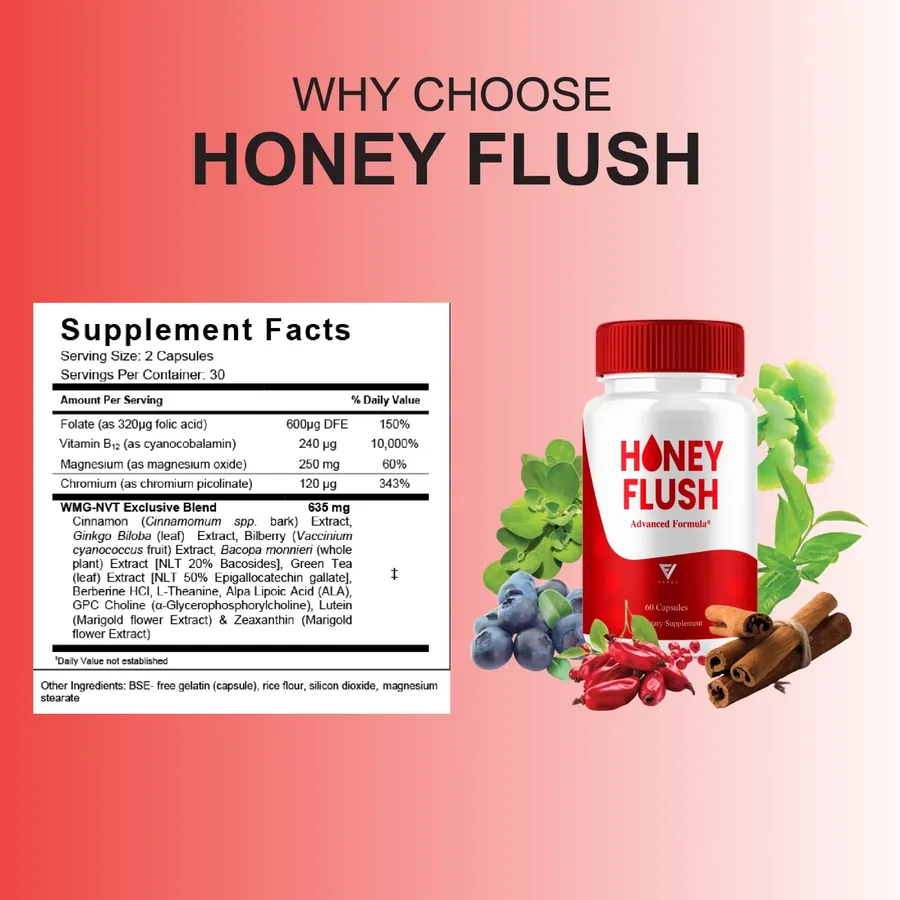
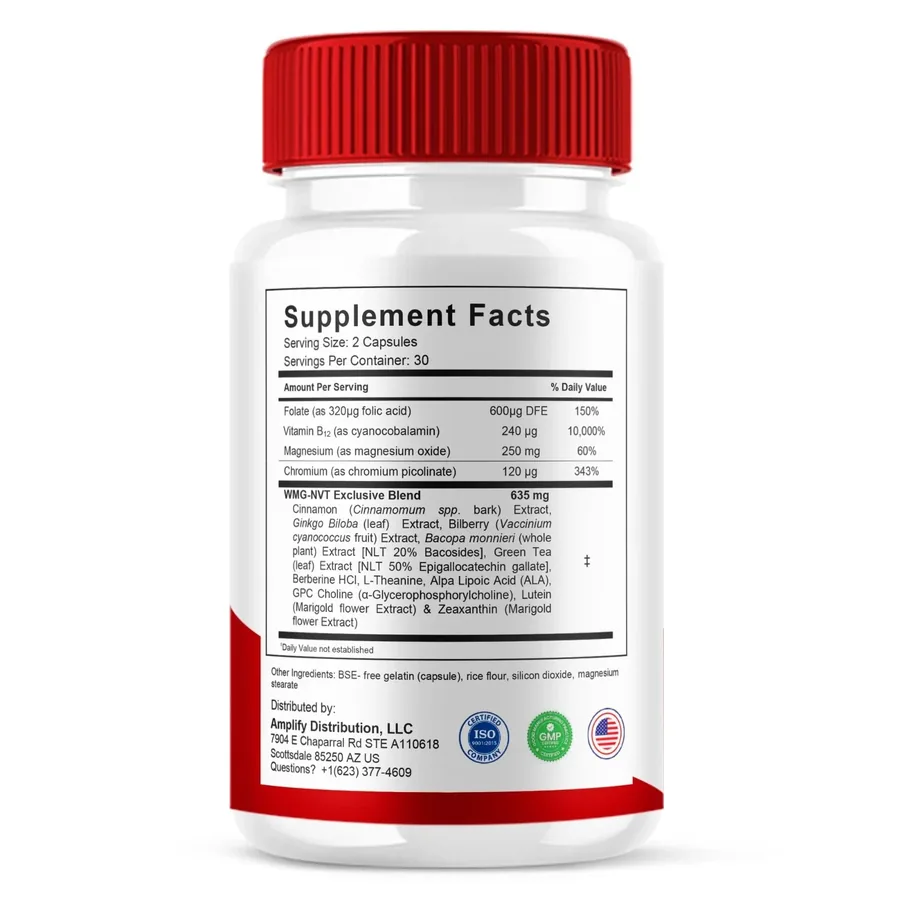
Folate (600 µg DFE, from 320 µg folic acid), B12 (240 µg), magnesium (250 mg) and chromium (120 µg) all have amounts. The WMG-NVT Exclusive Blend lists ten ingredients under one 635 mg total. US labeling rules list blend items from most to least by weight, so cinnamon is the largest share and lutein with zeaxanthin the smallest. The exact split is not published.
Studied doses
Berberine is usually studied at 500 to 1,500 mg a day (Berberine review, 2025). Bacopa trials mostly used about 300 mg of extract (Kongkeaw, 2014). L-theanine was tested at 200 mg (Hidese, 2019). The AREDS2 eye study used 10 mg lutein and 2 mg zeaxanthin in people with eye disease (NEI). Adding even three of these passes 635 mg, so the blend cannot match research doses for all ten.
Upper limits
This is the clear pass. Folic acid at 320 µg is under the 1,000 µg adult limit (NIH ODS). Magnesium at 250 mg is under the 350 mg supplemental limit (NIH ODS). B12 at 10,000% DV has no upper limit, and the body absorbs only a small share of large doses (NIH ODS).
Points 4 to 6: overlap, evidence and safety
These points depend on your own routine and on what research has shown. HoneyFlush scores partial on evidence and safety.
Overlap
If you take a multivitamin, add its folic acid and magnesium to the HoneyFlush amounts. Only 100 mg of supplemental magnesium fits beside HoneyFlush before the 350 mg limit. Our daily wellness guide shows the full math.
Evidence
Evidence varies by ingredient. Bacopa showed small effects on some memory tests over 12 weeks. NCCIH says cinnamon and ginkgo have not been shown to help any condition studied, and there is not enough evidence for bilberry (NCCIH; NCCIH; NCCIH). Berberine and chromium are studied in blood sugar research, but those results come from patients and do not transfer to healthy adults.
Safety
The label says not to use it during pregnancy or nursing. It does not print drug interactions, yet three blend ingredients have them: berberine may lower metformin levels and affect many other medicines (NCCIH), ginkgo may raise bleeding risk with blood thinners such as warfarin, and green tea extract has rare reports of liver injury (NCCIH). Our side effects page gives the full list.
Points 7 to 9: directions, quality and cost
HoneyFlush is partly clear on each of these. The gaps are small but worth knowing before you order.
Directions and claims
The label says: "Take 2 capsules daily (or as needed) or as directed by your health care provider." "As needed" leaves the amount open, so we suggest the plain 2 capsules daily. The arc panel says "Aids in detoxification," but detox is not a defined health benefit. The name says honey, yet no honey is listed.
Quality
The label prints "ISO 9001:2015 certified company" and "GMP certified." The lot number is HON-26/HO-7240. A certificate of analysis reference, HON-7240-26-HO, exists, but the document is not published. See the testing and quality page.
Cost and support
Prices are shown only at checkout. One bottle lasts 30 days, so divide the pack price by 30, 90 or 180 days for cost per day. Every order has a 60-day money-back guarantee, and the order desk answers at +1 (302) 200-3480.
Who might still choose HoneyFlush?
HoneyFlush may suit an adult who wants its four printed nutrients in one daily capsule routine and accepts that the blend amounts are unknown. It suits people less if they want exact doses of berberine, bacopa or L-theanine.
If a single blend ingredient is your main interest, a product that prints that ingredient's amount will tell you more. If you already take a full multivitamin, check the overlap first. Read the full label on the ingredients page before you decide.
Choosing an all-in-one supplement: common questions
What is the most important point on the checklist?
Printed amounts. Without them you cannot check doses, limits or overlap. HoneyFlush prints amounts for its four nutrients but not for its ten blend ingredients.
Why did HoneyFlush fail on doses?
Its whole blend is 635 mg. Berberine alone is usually studied at 500 to 1,500 mg a day, so ten ingredients cannot all be at research doses.
Is a proprietary blend always bad?
Not always, but it hides the split. By labeling rules, items are listed from most to least by weight, which gives an order but no amounts.
Can I use this checklist on other supplements?
Yes. The nine points work on any label that has a Supplement Facts panel.
Where do I find the lot number?
The HoneyFlush lot is HON-26/HO-7240. The lot and best-before date appear on the bottle base when shown.
Sources for this page
- NIH Office of Dietary Supplements. Dietary Supplements: What You Need to Know. Source
- U.S. Food and Drug Administration. Dietary Supplements. Source
- Berberine and health outcomes: an overview of systematic reviews. 2025. Source
- Kongkeaw C, et al. Meta-analysis of randomized controlled trials on cognitive effects of Bacopa monnieri extract. J Ethnopharmacol, 2014. Source
- Hidese S, et al. Effects of L-theanine administration on stress-related symptoms and cognitive functions in healthy adults. Nutrients, 2019. Source
- National Eye Institute. AREDS/AREDS2 Clinical Trials. Source
- NIH Office of Dietary Supplements. Folate: Fact Sheet for Health Professionals. Source
- NIH Office of Dietary Supplements. Magnesium: Fact Sheet for Health Professionals. Updated January 2026. Source
- NIH Office of Dietary Supplements. Vitamin B12: Fact Sheet for Health Professionals. Source
- National Center for Complementary and Integrative Health. Cinnamon. Source
- National Center for Complementary and Integrative Health. Ginkgo. Updated February 2025. Source
- National Center for Complementary and Integrative Health. Bilberry. Source
- National Center for Complementary and Integrative Health. Goldenseal (berberine). Updated February 2025. Source
- National Center for Complementary and Integrative Health. Green Tea. Updated February 2025. Source
Keep reading
Ready when you are
Order HoneyFlush from the authorized US retailer
60 capsules in every bottle, 2 a day. 60-day money-back guarantee. A real person at +1 (302) 200-3480 for orders, tracking and refunds.