Five questions
Does Honey Flush Really Work? 5 Questions to Ask First
Nobody can promise that Honey Flush works for you. Four nutrients have printed amounts and play normal roles in the body. The ten blend ingredients have no printed amounts, and most were studied at doses a 635 mg blend cannot hold. Ask the five questions below, then give it a fair, steady trial.
Key facts
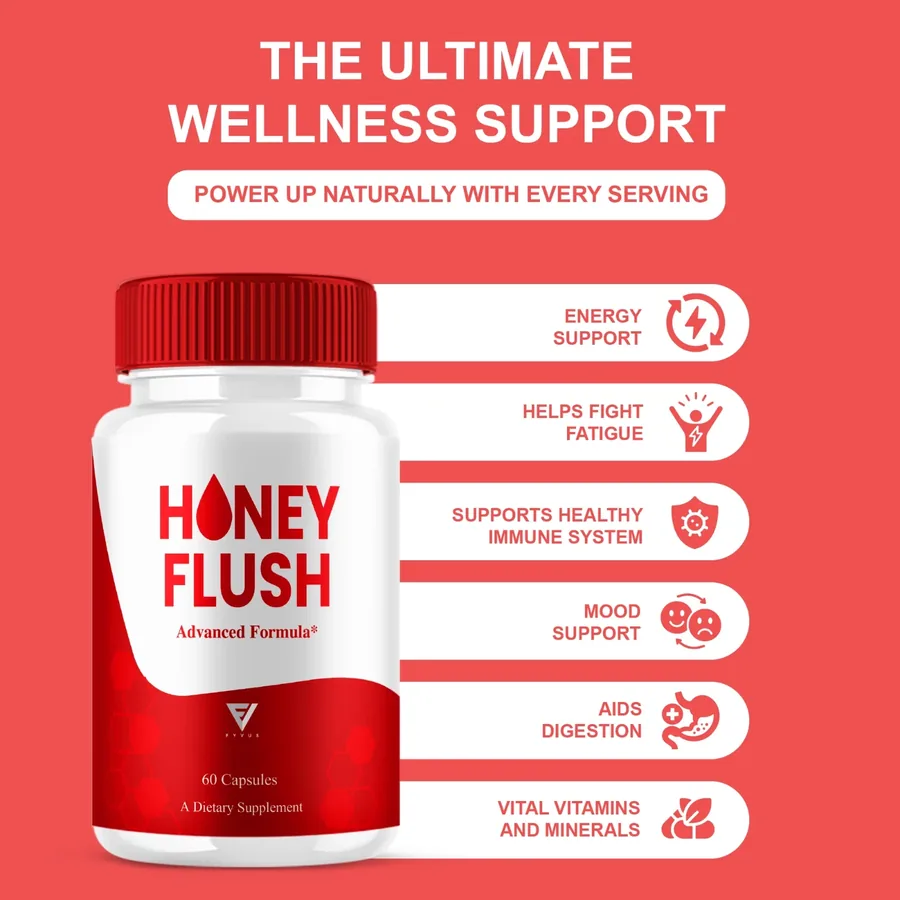
- The box makes support claims, such as energy support, mood support and mental clarity and focus. Each carries an asterisk.
- Those claims are not FDA evaluated, and the product is not meant to diagnose, treat, cure or prevent any disease.
- Exact amounts are printed for folate, vitamin B12, magnesium and chromium only.
- Ten blend ingredients share 635 mg, with no single amount printed.
- Most reviewers told the order desk they waited 3 to 4 weeks before judging it.
- There is no set timeline, and results vary from person to person.
Question 1: what is it supposed to work for?
Start with the claims, because “work” needs a target. The box lists support lines: energy support, helps fight fatigue, supports healthy immune system, mood support, aids digestion and vital vitamins and minerals. Another panel says it is designed to support mental clarity and focus.
These are support lines. They are not treatment claims. Honey Flush does not claim to treat blood sugar, blood pressure, weight or any disease, and we make none for it either. If you want help with a health problem, a doctor is the right first step.
Question 2: what do the four printed nutrients do?
These are the best-understood parts. Folate is used to make DNA and divide cells (NIH ODS, folate). Vitamin B12 helps make red blood cells and keeps nerves working (NIH ODS, vitamin B12). Magnesium takes part in hundreds of body reactions, including muscle, nerve and energy processes (NIH ODS, magnesium).
This is the plain link to the “energy support” line. These nutrients help normal energy processes. They are not stimulants. A nutrient makes the most difference when you were short on it. If your meals already cover B12, folate and magnesium, you may notice little.
| Nutrient | Per serving | Who may notice a change |
|---|---|---|
| Folate | 600 µg DFE | People whose diet runs low on greens, beans and fortified grains |
| Vitamin B12 | 240 µg | People who eat few animal foods, and some older adults |
| Magnesium | 250 mg | People who rarely eat nuts, seeds, whole grains and greens |
| Chromium | 120 µg | Study results are mixed, so expect no clear promise |
Question 3: can the blend hold research doses?
Here the answer is no for most of the ten. The blend is 635 mg in total. Berberine trials usually give 500 to 1,500 mg a day (berberine overview, 2025). Most bacopa trials gave about 300 mg of extract daily (Kongkeaw et al., 2014). L-theanine was tested at 200 mg a day (Hidese et al., 2019). Add just those three and you pass 635 mg.
Berberine is listed sixth, so five ingredients must weigh at least as much. That means the berberine in a serving is far under study doses. The label does not print the real amount, so no one outside the seller can say.
Question 4: what does the research say about the blend ingredients?
Read each item for what it is. The public sources named on the seller's pages are cautious.
- Cinnamon: studies have not shown a benefit for any health condition, says NCCIH (NCCIH, cinnamon).
- Ginkgo: NCCIH says it has not been shown to work for any condition studied, and it may raise bleeding risk with blood thinners (NCCIH, ginkgo).
- Bacopa: a review of trials found small effects on some memory tests, mostly at about 300 mg of extract a day for 12 weeks (Kongkeaw et al., 2014).
- L-theanine: one trial in healthy adults used 200 mg a day for 4 weeks (Hidese et al., 2019).
- Berberine: studied for blood sugar and cholesterol, mostly in people with those problems (berberine overview, 2025).
Notice the pattern. The positive findings are small, and they used amounts the label does not promise. So the fair reading is: possible, unproven at this dose, and not a reason to expect a big change.
Question 5: how long should you wait, and how will you know?
The seller states no set timeline. Its order-desk data says most reviewers waited 3 to 4 weeks. The top complaint was a slow start. Nutrients build up with steady intake, so a few days tells you very little.
Write a start note
Before day one, rate energy, focus, sleep and digestion from 1 to 5.
Take it the same way each day
Use the label serving of 2 capsules. Skipping days blurs the picture.
Rate again each week
Use the same scale, and note any change in diet, sleep or stress.
Compare at week four
Look at the notes. If nothing moved and you are unhappy, you still have time to use the 60-day guarantee.
Change one thing at a time. If you start a new diet or three new supplements in the same month, you will not know what did what.
So what is the honest answer on whether it works?
The honest answer has three parts. First, the four nutrients do real jobs in the body, and they help most when intake is low. Second, the claims for focus and mood rest on blend ingredients whose amounts are not printed. Third, reviewers are split: many liked the routine, and two three-star reviewers wanted a faster change and stopped at two bottles.
Frequently asked questions
Does Honey Flush really work?
No one can promise it. Four nutrients play normal roles in the body, but the ten blend ingredients have no printed amounts. Results vary from person to person.
How does Honey Flush work?
It has no single active ingredient. It adds four nutrients at printed amounts, plus a 635 mg blend of ten extracts and compounds. Each ingredient does what it does at the amount you get.
What are the benefits of Honey Flush?
The box claims support for energy, mood, digestion, immunity, mental clarity and focus. These are support claims marked with an asterisk, and the FDA has not evaluated them.
Will I feel Honey Flush on day one?
Probably not. The label lists no fast-acting ingredient, and most reviewers said they waited 3 to 4 weeks before judging it.
Can I take more to make it work faster?
No. The label serving is 2 capsules. More would push magnesium past the 350 mg upper limit for supplements.
Does Honey Flush treat any disease?
No. The label says it is not intended to diagnose, treat, cure or prevent any disease. Talk to a doctor about any health problem.
Sources for this page
- NIH Office of Dietary Supplements. Vitamin B12: Fact Sheet for Health Professionals. Source
- NIH Office of Dietary Supplements. Folate: Fact Sheet for Health Professionals. Source
- NIH Office of Dietary Supplements. Magnesium: Fact Sheet for Health Professionals. Updated January 2026. Source
- Kongkeaw C, et al. Meta-analysis of randomized controlled trials on cognitive effects of Bacopa monnieri extract. J Ethnopharmacol, 2014. Source
- Hidese S, et al. Effects of L-theanine administration on stress-related symptoms and cognitive functions in healthy adults. Nutrients, 2019. Source
- National Center for Complementary and Integrative Health. Ginkgo. Updated February 2025. Source
- National Center for Complementary and Integrative Health. Cinnamon. Source
- Berberine and health outcomes: an overview of systematic reviews. 2025. Source
Keep reading
Our view
Our view is cautious. Honey Flush is easiest to understand as a multivitamin-style capsule plus a sprinkle of popular extracts. The nutrients are the part you can measure. The blend is the part you take on trust.
If you try it, treat the first month as a test. Keep a short log, hold the rest of your routine steady and decide before day 60. This is not medical advice, and it is not a promise of results. A doctor or pharmacist should review the label if you take any medicine.
Last updated November 4, 2026. Medically reviewed by Dr. Joette James, PhD.
When you are ready
Judge it with the facts in hand
The order page shows the live price and the 60-day guarantee terms, which give you room for a fair trial.
We earn money when you buy through our order links.